
Dark of the Night Network
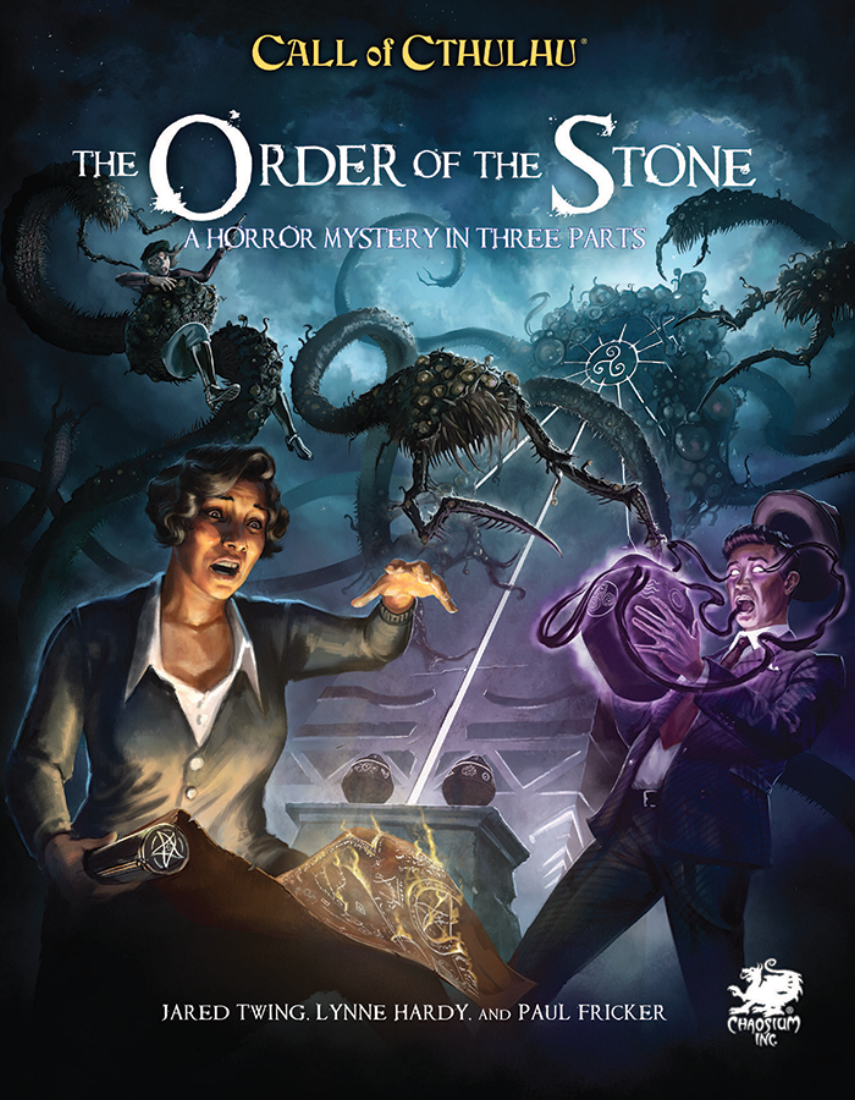
The Order of the Stone
A Horror Mystery in Three Parts — Chaosium Inc.
It arrived without postage, as the significant ones tend to.
The cover was clean, and that alone made me suspicious. I have been here long enough to know a clean cover means either careful preservation or something that wants to be picked up, and I have not yet filed a finding on which applies.
I read it twice — once with bunker coffee of uncertain vintage and once with something from a bottle whose country of origin does not appear on current maps. The second reading was more accurate. This tracks.
The artifact: The Order of the Stone, a three-part Call of Cthulhu campaign written by Jared Twing, Lynne Hardy, and Paul Fricker and published by Chaosium. It is set in the 1920s, and — pay attention here, dear witnesses — completely earnest about what it is doing.
Earnestness is rarer than it looks in this space, and I noted it.
The Premise
Filed Without Comment
Thousands of years ago a druidic sect made a decision that required paperwork. The paperwork became an organization, the organization became a secret society, and the secret society became — eventually — a comfortable club for old money smoking-jacket types.
It's just how these things go.
Your investigators arrive at the tail end of a chain of events that starts at a dig site in Ireland, crosses the Atlantic on a steam liner, and ends somewhere in the wooded hills of Massachusetts — with ancient artifacts, a shadowy academic, a secret society that has forgotten more than it remembers, and something very old and very patient along for the ride.
Something ancient was locked away for very good reasons, and someone with impressive credentials has recently taken an interest in it.
The setting is 1920s Arkham, with Miskatonic University casting its usual shadow and the rural Massachusetts interior playing at the ambience. It looks like the world your investigators know but, on close inspection, it's not.
The Structure
Architecture Assessment
Three acts with three distinct settings, and each one earns its place.
A steam liner is adrift in the icy waters off Boston. Investigators board to look into it and find the aftermath of something — though whether that something is finished is a question the campaign holds back until you've had a chance to look around. A sealed ship is a specific kind of horror environment with a claustrophobia this one earns honestly and the application of this setting is upsetting as appropriate. Arrive, explore, and leave with more questions than you came with.
A Massachusetts fishing town with a fresh corpse and strange factions. The investigators are not the only ones in Greyport looking for answers and the others are not on the same side as each other — or as the investigators. This is where the campaign opens up into something more social, with conversations that matter, relationships with weight, and a town that rewards curiosity. It is more complex than Act One, and what you do here determines what you have access to later.
Into the woods, where the trail leads and everything the investigators uncovered across the first two acts determines what they are able to do when they arrive. The Massachusetts interior is unforgiving and the finale asks what the investigators are made of with no curve applied to the grading.
The Design
On Which I Have Opinions
The campaign runs in both Classic and Pulp Cthulhu modes — Classic is heavier on dread and Sanity attrition, while Pulp moves faster and hits harder. The structure holds up either way because it is built around plot logic rather than tone.
Multiple factions are in play, and who they become to the investigators depends entirely on how the investigators approach them. There is more than one way through, and that is worth saying plainly.
Six pre-generated investigators are included — all crew of a fishing trawler called the FV Foggy Sea — with people who work the Atlantic professionally bringing a specific relationship to what the Atlantic contains. It is a good starting premise, and the campaign also works with existing investigators or newly built ones if the group prefers.
The Verdict
Which the Evidence Has Been Building Toward
The Order of the Stone respects the intelligence of everyone at the table, treats the mystery as something worth solving, and builds across three distinct settings without losing the thread.
It plays like a novel which is a fascinating and unique approach. Ship to town to wilderness, with each act carrying its own atmosphere and its own mode of play. The campaign earns the escalation because it does the work at each stage.
For veterans, the 1920s Arkham setting is familiar ground and the campaign uses that familiarity well — the strangeness lands harder because the surroundings feel known. For new investigators, it is a clean entry point with no prior reading required.
Ancient things and secret organizations, with a trail across the Atlantic and into the Massachusetts dark. The campaign knows what it is and commits to it.
Heard in the Wild
Field Recording — Recommended Transmission
Before you acquire the artifact, consider listening to people who have already been through it.
The Apocalypse Players is an actual play podcast worth your time. Good Keepers. Good players. They recently ran The Order of the Stone in a crossover with Mystery Quest. The result is a clean demonstration of what this campaign does when handled well.
It is spoiler-laden by nature. Listen after you have run it or after you have decided you never will. Either way it is worth your time.
The artifact has been recovered, assessed, and cleared for release.
Acquire the Artifact