
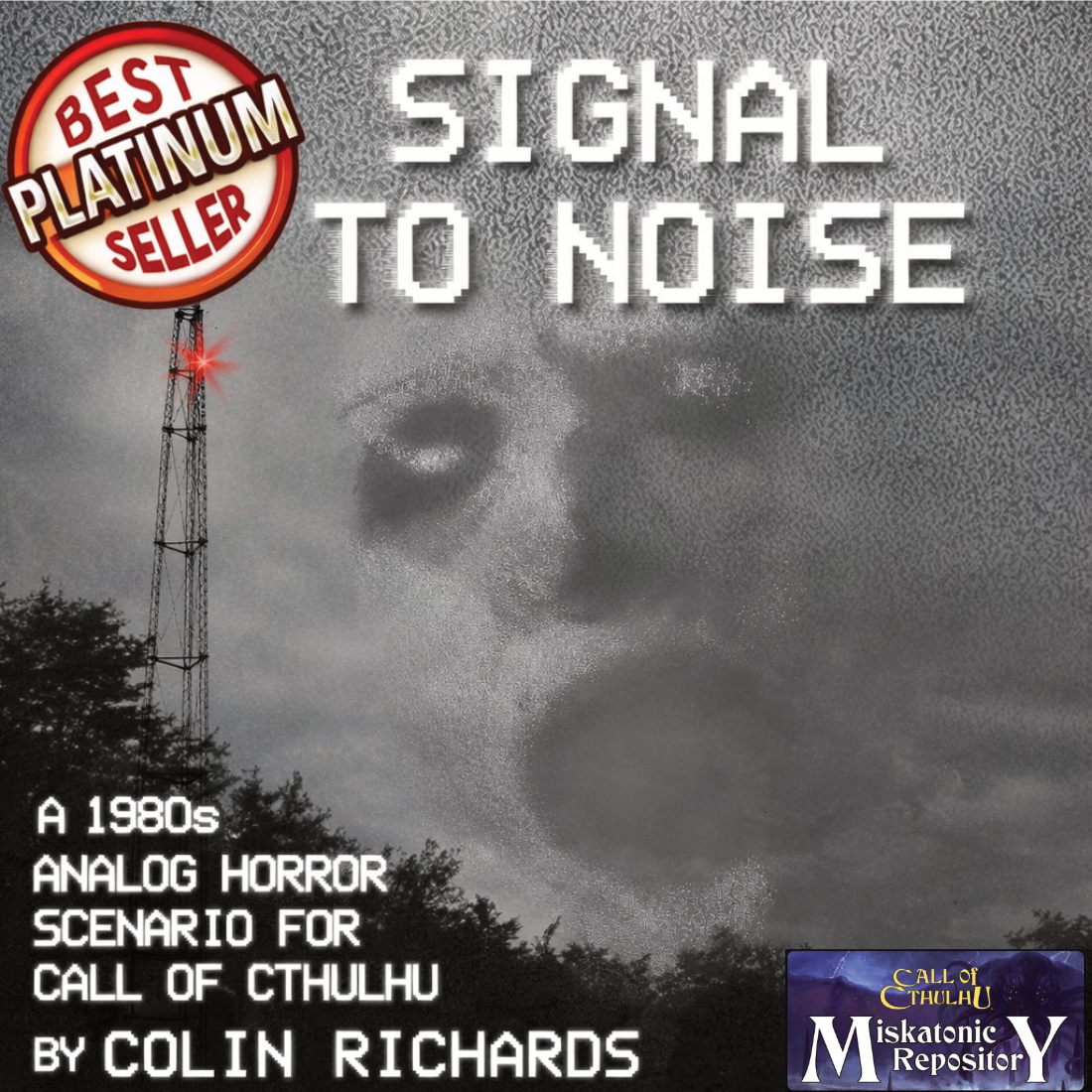
Signal to Noise A Transmission Assessment by Vesper Vane, Midnight Archivist
The artifact arrived on my desk at some point between the second and third pot of coffee. The cover was damp, though it hadn't rained in Pennsauken for eleven days. I wiped it down, read it through twice, and am pleased to report that whatever it tracked in from wherever it came from has so far declined to spread to the filing system.
Here is what you need to understand about Signal to Noise, delectable temporaries: it arrives already knowing what you are afraid of. Not the large, theatrical fears — not the teeth and the tentacles and the unpronounceable syllables reverberating from before recorded time. The small ones. The domestic ones. The television in the living room that shows you something it shouldn't, briefly, just long enough to make you doubt whether you saw it at all. The child who was there a moment ago and is simply, inexplicably, not there anymore. The engineer who hasn't come to work in a week and left his lunch in the refrigerator and his keys on the counter. Signal to Noise is a scenario built from the horror of normalcy gone precisely one degree wrong, and it is very good at it.
The setup is admirably mundane in its packaging. It is 1989, and a regional Pennsylvania television station called WSHP-TV Channel 17 has had its signal hijacked four times in six weeks. The broadcasts are strange, so the station president wants it stopped before it derails his mayoral campaign, naturally. The investigators assemble, and the tape rolls.
And there it is. The moment the tape plays, the investigators are already marked. Colin Richards understands something that a great many designers of this style of scenario do not: the most effective horror is delivered before the player knows to be afraid. By the time your table has sat through Video #3 and heard the Emergency Broadcast tones and watched the text read WE WATCH YOU WATCH US, the damage is already done. The investigation phase that follows is experienced by investigators who are already compromised, already changed — they simply don't know it yet. The paranoia is, for once, not manufactured by dice rolls but an accurate assessment of the situation.
— V. Vane, filed notes, bunker archive
The investigation itself is structured with unusual generosity. There are multiple avenues, multiple handouts, multiple characters whose information overlaps, corroborates, and drives them onward, and a timeline that the Keeper can pace with real flexibility. Calvin McClosky — the sweating, paranoid television repairman who is himself already being stalked by the thing he refuses to name — is a particular achievement. He is comic in the way that all truly terrifying people are comic: he is right, he is alone in being right, and he is spending his last functional weeks watching a television set, hoping to record proof of the thing that is going to take him. I have filed a note about him. The note is not optimistic.
The Gray Woman earns her presence on every page she haunts. At the furthest margins of the scenario she is a doodle in a dead engineer's notebook. In the middle distance she is a figure at the end of a hallway who was not there when you looked again. By the time she fills the attic of the Forsaken House and herds your investigators into the Impossible Hallway, she has built to something that does not require mechanical justification. The scenario trusts the escalation it has constructed, and that trust is warranted.
The Signal Realms — the second, survival half — is where Richards commits to something genuinely ambitious: a place made by entities who observe our world entirely through its broadcasts and have assembled their understanding of it accordingly. Everything is wrong in the way that a translation is wrong when the translator has never spoken the language, only read the dictionary. The studio audience encounter, the impossible forest with its carpet floor, the library of VHS tapes that are not recordings but windows — these are not random unsettling images. Coherently, they describe a particular kind of incomprehension that is both hilarious and awful in the way that all truly alien intelligence should be. The Signal Beings do not hate your investigators — they simply do not understand them, which is, reliably, worse.
Frank Mars is in there. I will not say more about Frank Mars. If you would like to know more about Frank Mars, you will need to go to the Screaming Library and find the right shelf. Bring the Signal Jammer. This is not optional advice.
The scenario provides five pre-generated investigators with clean, functional skill spreads and enough personality scaffolding to be useful without being prescriptive. The bouts of madness appendix is presented as individual slips of paper for the Keeper, which is the kind of production thinking that separates a scenario that has been thought through from a scenario that has been written up. The handouts are genuine handouts — artifacts with texture and age and the specific illegibility of things that have been through something. The videos are real — the link is in the document — and I have watched them. I had to file a brief note for my therapist about the videos.
— V. Vane, supplementary field note
What Richards has built here is a scenario that respects the intelligence of both Keeper and player, that understands pacing at the structural level, and that contains enough flexibility in the hands of a table that needs to breathe and enough momentum to carry a table that needs to move. The multiple endings are not tacked on but emerge naturally from what the scenario has established. The darkest of them — which I will not describe here, for reasons that should become apparent once you reach the relevant page — is the kind of ending a scenario has to earn.
The signal intrusions have not stopped in Summit Heights. Relay Station #2 has been quiet for some time, but the filaments grow back. This is the nature of certain kinds of contact: what has been opened does not close. Your investigators will know this by the end of the scenario — know it in their nerves, which will no longer conduct electricity quite the way they used to.
Artifact Assessment
The frequency has been established. The signal found you the moment you started reading this, which means the question is simply whether you would prefer to acquire Signal to Noise before or after your investigators start noticing things in the corner of their eye.
The algorithm flagged your table as harmless, but it has been wrong before.